Pre-training
FAST + VLM
Co-train vision-language supervision and discrete FAST action tokens to align multimodal features with robot behavior.
Broad action priorsA Vision-Language-Action Foundation Model for Desktop Manipulation

Meituan-Robotics-0 (MR0) is a vision-language-action foundation model and embodied-agent system for stationary-base desktop manipulation. It combines 147 million vision-language samples with 15,060 hours of robot trajectories, then transfers these priors to continuous control through a three-stage training recipe. The standalone policy reaches 93.6% success on RoboTwin 2.0. It achieves an average success rate of 14.63% on RoboDojo, as reported in Table 5. Real-world post-training uses demonstrations and human corrections; Rollback pairs replaced policy segments with corrective continuations for CFG-DAgger. The event-driven agent adds persistent task memory and condition-aware resumption for long-horizon execution.
The training corpus combines broad visual-language supervision with curated robot trajectories across 12 embodiments. Vision-language data supplies semantic coverage, while the robot corpus combines RoboDesk, licensed real-robot data, and open simulation data to ground that knowledge in executable behavior.
147 million samples provide both general visual understanding and embodied grounding. General data accounts for 78% of the mixture, while embodied data contributes the remaining 22%. The embodied portion covers visual grounding, affordance grounding, scene captioning, and task planning. The general portion covers visual grounding and counting, general VQA, and spatial understanding.

The final robot corpus contains 15,060 hours of retained tabletop trajectories across 12 embodiments. It comprises 3,235 hours of curated open-source real-robot data from RoboDesk, 7,530 hours of licensed real-robot data, and 4,295 hours of open simulation data. In total, 10,765 hours come from physical robot execution. The corpus is restricted to stationary-base manipulation and excludes segments containing base motion.
Duration (hours)
The method combines a three-stage training recipe with an event-driven agent. Discrete action-token pre-training establishes broad behavioral priors, continuous flow-matching mid-training transfers them to precise cross-embodiment control, and closed-loop post-training adapts the policy to errors encountered during real-world deployment.
The three stages separate broad multimodal learning from continuous control and real-world adaptation. SFT initializes a task policy for data collection. HG-DAgger, RECAP, and CFG-DAgger are alternative post-training strategies: each is trained anew from the same mid-training checkpoint using cumulative data, not sequentially applied to one policy.
Co-train vision-language supervision and discrete FAST action tokens to align multimodal features with robot behavior.
Broad action priorsReplace discrete action prediction with continuous flow matching over a unified end-effector representation.
Coherent action chunksLearn from demonstrations and corrections. Rollback additionally retains replaced policy segments as negative supervision for CFG-DAgger.
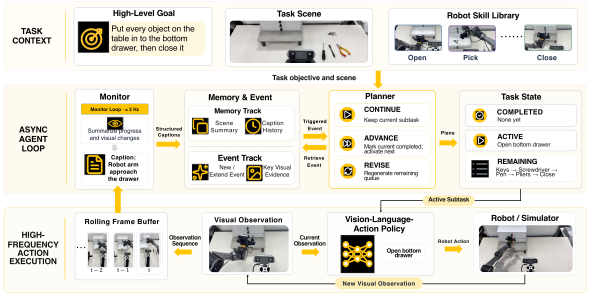
Closed-loop policy optimizationA Monitor, Memory Manager, and Planner operate above the VLA policy at different rates. The Monitor summarizes short visual windows, the Memory Manager converts them into persistent events with supporting keyframes, and the Planner is invoked only when an event changes task progress or feasibility. Low-level control therefore continues at robot frequency while the system preserves cross-task state and resumes objectives after temporary interruptions.
Evaluation spans simulation benchmarks and physical robot deployment. Simulation measures standalone-policy transfer, while real-robot studies report success rate (SR) and progress score (PS) under matched post-training protocols.
We evaluate MR0 on RoboTwin 2.0, RoboDojo, and three real-robot tasks: letter-block placement, garment folding, and Ethernet insertion. The RoboDojo comparison retains the selected baselines from Figure 1 and uses average success rates from Table 5.
Real-robot demonstrations show the policy executing precise bimanual manipulation and the agent preserving task state across interruptions.
Three desktop tasks cover ordered placement, deformable-object handling, and contact-rich insertion. The set stresses sequencing, bimanual coordination, recovery from local errors, and fine geometric alignment. Videos illustrate the tasks; the metrics summarize the paper's evaluations: HG-DAgger for letter-block placement and garment folding, and CFG-DAgger for Ethernet insertion. SR requires full completion; garment folding must finish within 120 seconds. Folding trials continue for up to 300 seconds, and later completion counts as failure for SR but retains its completion time for PS. PS measures consecutive correct placements for blocks, time-based execution efficiency for folding, and completed grasping, handover, and insertion milestones for Ethernet insertion.
Two deployment traces illustrate persistent event memory and conditional recovery. These videos are qualitative cases rather than an aggregate success-rate benchmark.
While the screwdriver subtask continues, a person moves the key from the bottom drawer to the middle drawer. The agent stores that event and later retrieves the key's last observed location for a new instruction.
When the key is temporarily removed, the agent preserves the pending placement objective and waits. Its return triggers reassessment, allowing the original instruction to resume and complete.
Meituan-Robotics-0 connects aligned heterogeneous data, continuous cross-embodiment control, closed-loop policy optimization, and event-level memory in one desktop-manipulation system. The evaluation shows that broad pre-training supports transfer, human interventions improve recovery from policy-induced states, Rollback pairs support CFG-DAgger for precision-sensitive insertion without value learning, and persistent events extend planning beyond the current observation.
Please cite the technical report when using this work.
Meituan Robotics Team. “Meituan-Robotics-0: A Vision-Language-Action
Foundation Model for Desktop Manipulation.” arXiv:2611.08577, 2026.
https://arxiv.org/abs/2611.08577